Gooseneck vs Bumper Pull: Which Should You Buy?
Gooseneck or bumper pull? A 30+ year dealer on what you haul, where the weight sits, what the truck can actually do, and why customers who have pulled both don’t go back.
· The Trailer Store, Winnemucca, Nevada
If you walk into The Trailer Store and say you need a trailer, the first question is not bumper pull or gooseneck. It is what you are planning on hauling.
That answer does most of the work. Hay, feed, and pellets push a lot of people toward a deckover, and that deckover is usually a gooseneck. Backhoes, farm equipment, skid steers, mini excavators, and rental equipment do the same. A lighter, occasional load on a truck that already has a receiver can stay a bumper pull and be the right call.
A lot of buyers already have their mind made up before they ask. When they do ask, the difference that matters is where the weight sits.
Weight over the axle, or weight on the bumper?
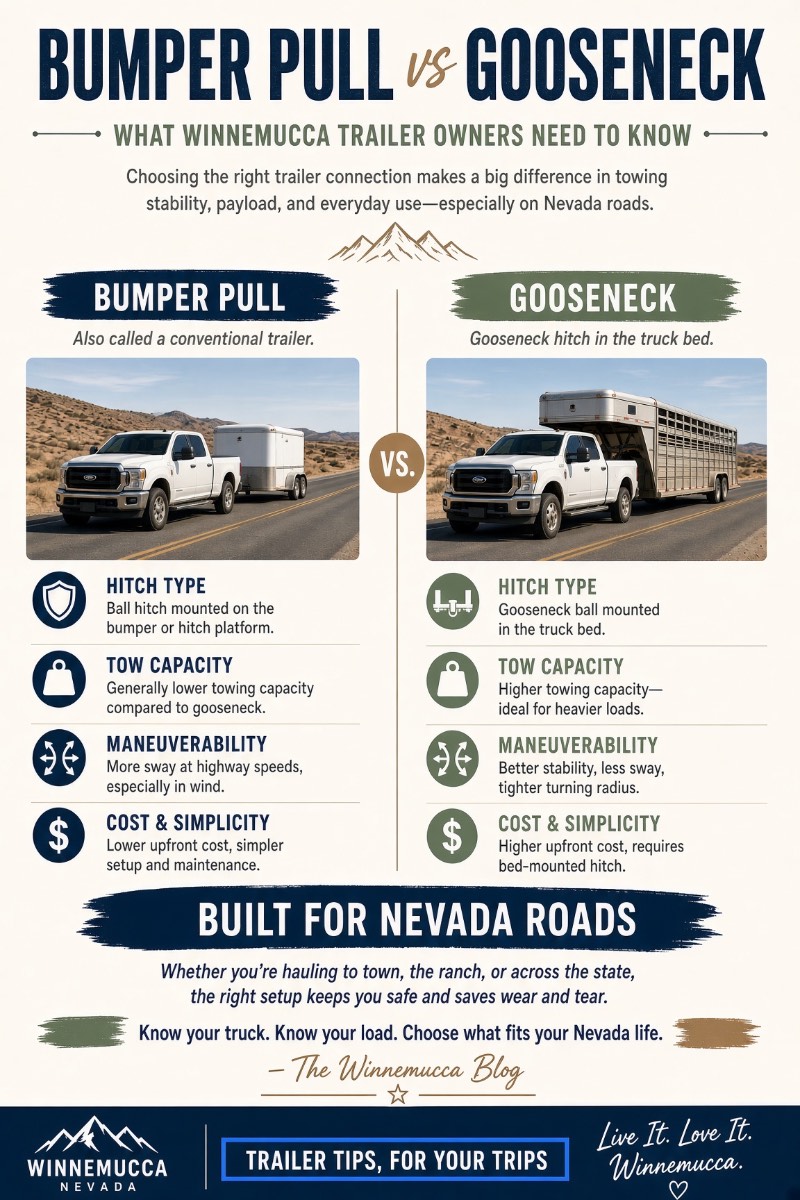
A bumper pull puts tongue weight on the ball behind the truck. A gooseneck puts that weight on a ball in the bed, over the rear axle.
That is why a gooseneck tows more capably and sits more even when the load is right. The trailer is not levering on the back of the bumper. It is bearing down through the axle. People who have owned both do not describe it as a small difference. They describe it as stability, turning radius, and how the rig backs.
A pintle hitch does not change that. A pintle is still a bumper pull. The lunette and the hook sit behind the truck, same as a ball in the receiver. It is not a gooseneck.
What we actually see hauled?
Around here the gooseneck deckover earns its keep on bulk and on iron.
Hay, feed, and pellets want a flat deck you can drive at from the side, and that is the layout most goosenecks already have. The same customers are also loading backhoes, farm equipment, skid steers, mini excavators, and rental machines. Those loads can sit on either hitch if the trailer and the truck are rated for them. The gooseneck is the one that keeps the rig level and predictable once the weight gets serious.
There is no single pound number where a bumper pull stops being honest. Loaded weight is a truck question before it is a trailer question. Some trucks will handle a loaded 23,000 or 24,000 pound bumper pull. Some of this work is not a pickup job at all. Semis and dump trucks show up too, and if they are on a pintle, that is still a bumper pull. You have to know the truck.
The truck decides more than the brochure
A gooseneck hitch on a half-ton is not unheard of. Not every hitch is built the same, and some people simply prefer the gooseneck, especially on a smaller trailer. Horse trailers are the obvious case.
If you want the gooseneck’s full capability, the truck should be a three-quarter ton or heavier. Below that you can still tow a lighter gooseneck. You are not getting what the hitch design is for.
Look at all of it before you buy. The door sticker. The tow package. What the manufacturer rates that truck for. Payload left after the hitch, the people in the cab, and whatever else is already in the bed. Then be honest about your own experience.
Age and mileage count. A new F-450 and a 1975 pickup are not the same tool. Brakes, power, and the rest of the chassis are in a different class. Modern trucks are far ahead of what came before them, and that gap keeps opening.
If you have never towed anything heavy, do not jump from nothing to the biggest trailer on the lot. Start on a bumper pull. Get used to the weight. Then step up.
Why the people who have pulled both don’t go back?
This part is not theory. Customers who already own a gooseneck will take a gooseneck over any other trailer, and they are not guessing. They have towed bumper pulls. The gooseneck is the one they keep.
What they talk about is load stability, turning radius, and backing. The comfort level is higher once you have done it a few times. The learning curve is real. It is also short if you are not afraid of it.
The disadvantage is the truck, not the trailer. A gooseneck hitch is not on every vehicle in a fleet. If the bed did not come with a factory puck system, somebody has to install one. A bumper pull uses the receiver almost every pickup already has.
Commercial rigs are a different story. A lot of those trailers stay hooked up. They are not cheap, and they are earning their keep. Climbing into the bed to couple and uncouple every night is a weekend problem, not a job-site problem.
What it costs?
Apples to apples, the gooseneck option on the same trailer starts around $1,500 to $1,800.
The other cost is the hitch, if the truck is not already set up. B&W and Curt are the names to buy, or an OEM hitch. If the truck has a factory puck system, you are buying the ball and hook kit, and those kits have gotten easier to install. The guys who live on a gooseneck still tend to prefer a B&W over the puck system. Not because the puck system is bad. Because they trust the B&W.
Do not buy a Chinese import knockoff hitch. Buy the real factory piece. B&W, Curt, or OEM.
A bumper pull skips that bill. It is cheaper, and the receiver is already on the truck. No bed install. No climbing in to hook up, if you are the person who couples and uncouples a lot.
Which one to buy?
Bumper pull if the load is lighter, the price matters, you hook and unhook often, or more than one truck in the fleet needs to pull it. It is the common hitch. It is the right place to learn if this is your first heavy tow.
Gooseneck if you are hauling equipment, hay, vehicles, or anything else where stability and turning actually matter, and you are not afraid of a short learning curve. That is the suggestion after years of customers who have pulled both. They do not go back.
If you are still on the fence, bring the truck and tell us what you haul. The trailer is the easy part. The truck, the hitch, and the load are the decision.
The Trailer Store
Winnemucca, Nevada
ttsnv.com